Location
Germany, Bavaria, Munich
Catholic parish church St Michael in Munich, Berg am Laim (Kath. Pfarrkirche St. Michael in München, Berg am Laim)
Artwork
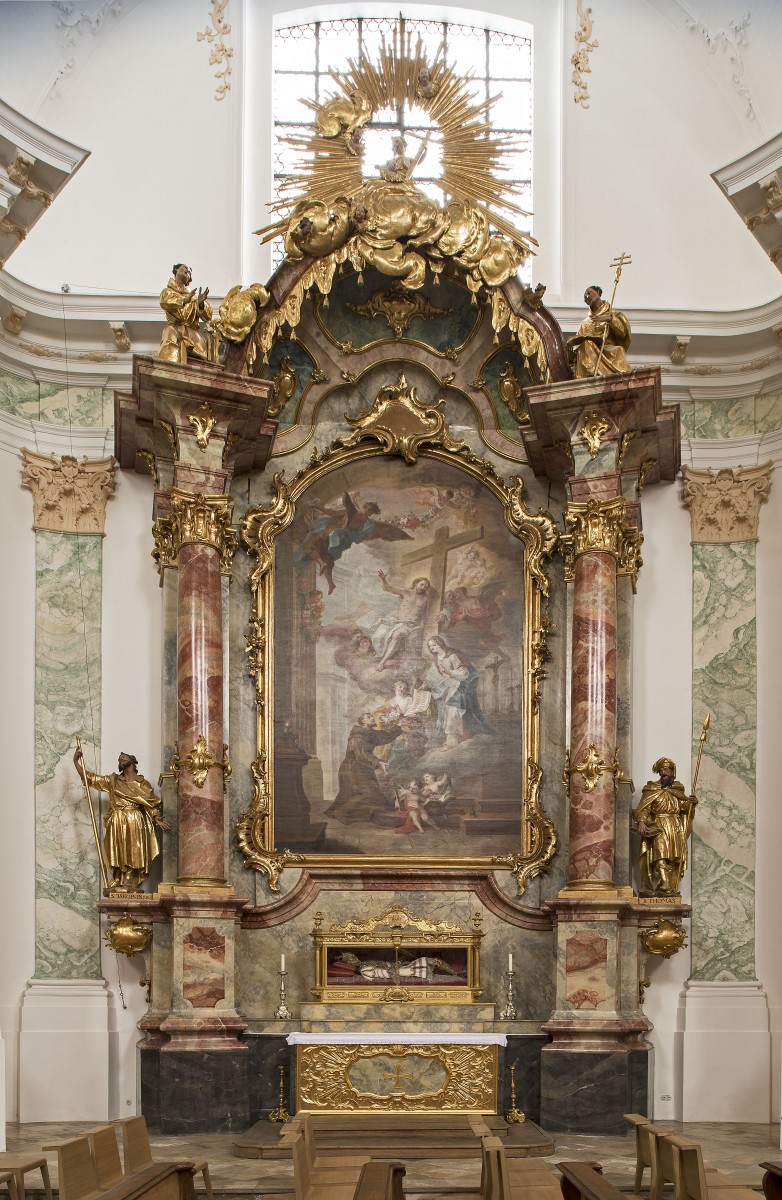
The large side altar (north), Portiunkula altar of the catholic parish church, former court-, knightsorder- and archbrotherhood church of St Michael in Munich, Berg am Laim
Type
Side altar
Dimensions
Height: 1074 cm, width: 722 cm
Critical History
27.3.1758 contract with J.B. Straub for the large side altars (together 1100 fl.). The altar in the south was to replace an older Portiunkula altar mentioned in 1752.1
1759 transport of the statues and decorative elements in eight carts and probably also erection of the side altars. Already 1745–1746, the altarpiece was made by J. B. Zimmermann (signature: "Zimerman i.ven et pinxit 1746") (200 fl.?). The altars of St Mary and St John Nepomuk, which had been provisionally erected instead of the large side altars, were moved to their current location. The painting of the architecture of the large side altars was made in 1762 by Johann Michael Kaufmann (1000 fl.).2 Who the Kistler of the two large side altars was is not known. Brünner mentions Ignaz Settele, who had his workshop next to the Straub (Hackenstr 10) and was Straub's best man in 1743. N-3#. The kistler does not appear on his own in the bills, but was part of the contract to Straub.
- Sketch of the Portiunkula altar attributed to Straub, about 1758, black feather, watercoloured in grey, pink image surface, 41,1 : 28,5, top right inscription: "Sebastian Sell / cassier", Munich, Staatliche Graphische Sammlung, 30494. Questionable attribution by Giedion-Welcker.4
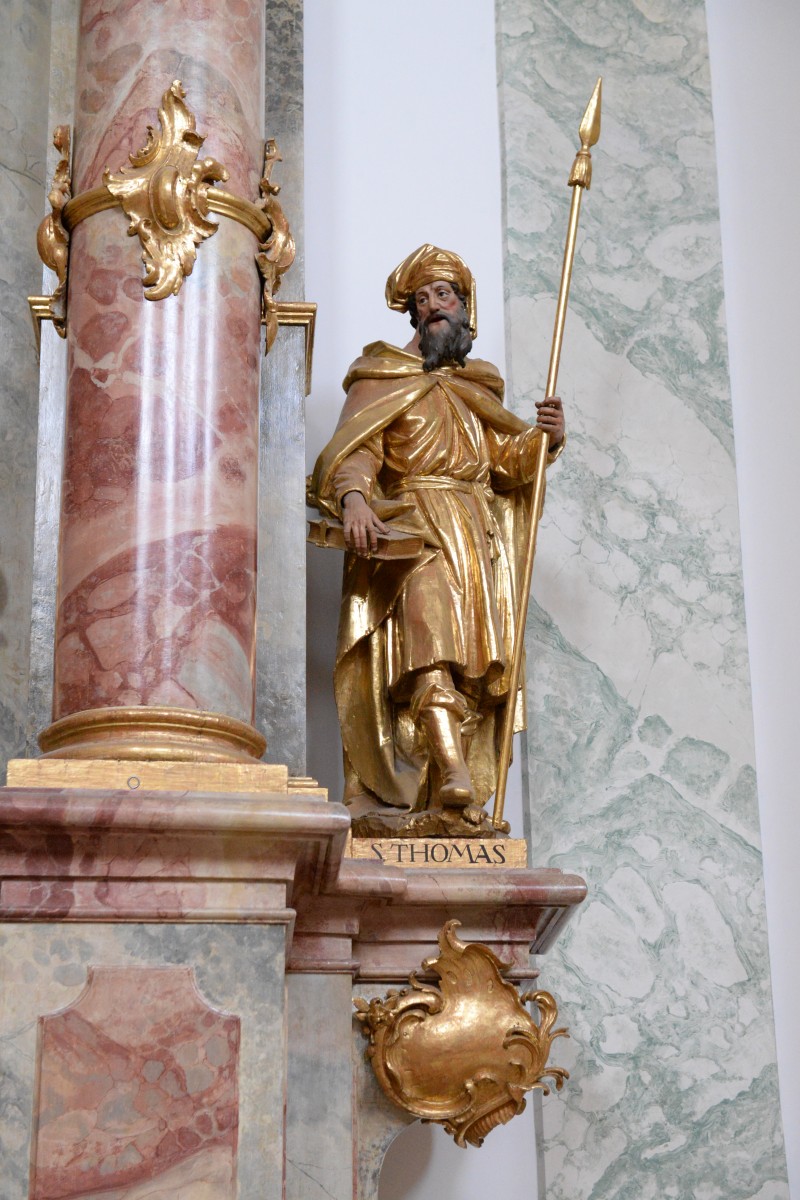
The large side altar (north) with altarpiece of the "Origin of the Portiuncula discharge in 1216" flanked by statues of the Apostle Jakobus d.J. (left) and Thomas (right). In the coronation gloriole with Christ child adored by St Anthony of Padua (left) and St Bonaventura (right). The two large side altars are nearlly identical. The pillar / column axes are tilted and thus the curvature of the room is recorded. The altars arrange very unspectacular with the room. All the side altars are connect by a complete apostles cycle.
Construction / Execution
Wood, colored with naturalistic incarnation, the altar architecture marbled. The figures, the picture frame an the upper part are completley gilded in the last renovation 2005–2009
Components
- Carpentry
- Large side altar (right) Portiunkula altar of the catholic parish church, former court-,knightsorder- and archbrotherhood church of St Michael in Munich, Berg-am-Laim
- Author: Franz Ignaz Settele
- Completed: 1758 – 1759
- Patron(s): owner, monastery
- Technique(s): wood carving
- Sculpture
- Large side altar (right), Portiunkula altar of the catholic parish church, former court-, knightsorder- and archbrotherhood church of St Michael in Munich, Berg-am-Laim
- Author: Johann Baptist Straub (Wiesensteig ca. 1704 – Munich 1784)
- Completed: 1758 – 1759
- Patron(s): owner, parish
- Technique(s): wood carving
- Polychromy
- Large side altar (right), Portiunkula altar of the catholic parish church, former court-, knightsorder- and archbrotherhood church of St Michael in Munich, Berg-am-Laim
- Author: Johan Michael Kaufmann
- Completed: 1762 – 1762
Comment
Possibly not only for the Portiunkula altar but also for the opposite Holy Family altar a (provisional?) previous altar existed. An altarpiece was already produced by Zimmermann 12 years before the contract with Straub for the new altar and completion of the altar architecture.
Findings of the first setting during the Restoration 2005–20095 : The primed wooden surfaces were sealed off with glue, followed by a multi-layer application with stone chalk. Bright gold was given a finer white plaster base. The northern side altar was worked more careful than the southern one. The original gilding shows a change from bright gold and matt gold as well as an economical use of gold and the small format of glass blanks over yellow and red bolus. The marbling is partly provided with pencil etchings. The original covers are mainly made of Sandarak with additions of turpentine oil and drying oils on the high altar with significantly more oil content.#N-6 #
Conservation-restoration
- 1945/46
Treatment Description
1945–1946 new gilding of reliquary shrine
- 1980-82
Treatment Description
1980–1982 cleaning and partly new gilding by the company Mayerhofer, carpenter repairs
- 2008
Treatment Description
Last restoration 2008–2009 by company Erwin Wiegerling.7:
Conservation, dry and damp cleaning, removal of coatings and additions of the last restoration, stabilization of the marbling, stabilization of the architecture, repair of defects with gesso, retouching with acrylic or watercolor, supplement damages of the gilding. Restoration of the piedestal and the back of the antependium with acrylic-based colours.
Images
- Large side altar (north) of the catholic parish church, former court-,knightsorder- and archbrotherhood church of St Michael in Munich, Berg-am-Laim, Photo: BLfD Michael Forstner, 2017
- Large side altar (north) of the catholic parish church, former court-,knightsorder- and archbrotherhood church of St Michael in Munich, Berg-am-Laim, Photo: M. Mannewitz, 2018
Catalogue entry prepared by Martin Mannewitz
Recommended citation: Martin Mannewitz, The large side altar (north), Portiunkula altar of the catholic parish church, former court-, knightsorder- and archbrotherhood church of St Michael in Munich, Berg am Laim, in: TrArS – Tracing the Art of the Straub Family, 2018, (accessed 02/07/2026) URL
