Location
Germany, Bavaria, Schongau
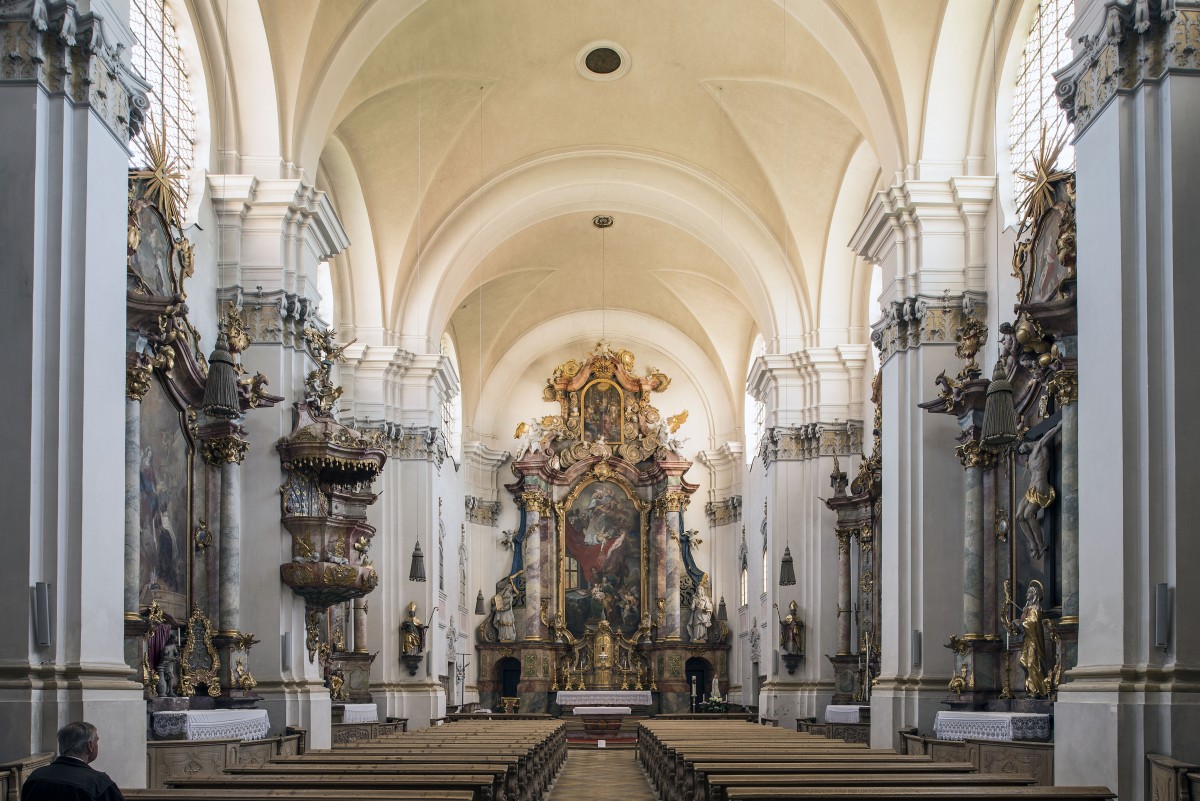
Hospital Church of the Holy Spirit (Heilig-Geist-Spitalkirche St Anna)
Catholic parish of Assumption of Mary
Artwork
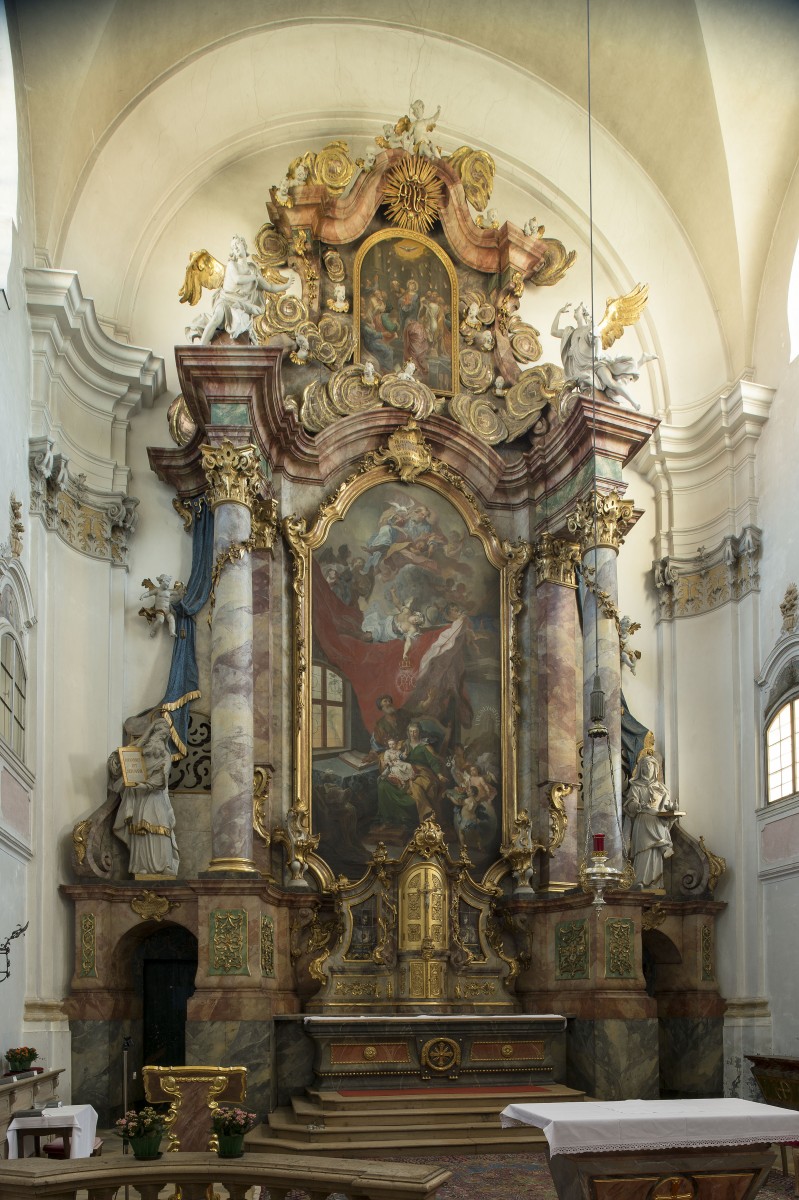
High Altar of the Hospital Church of the Holy Spirit in Schongau
Type
High altar
Dimensions
Height: 1435 cm, width: 903 cm
Inscriptions
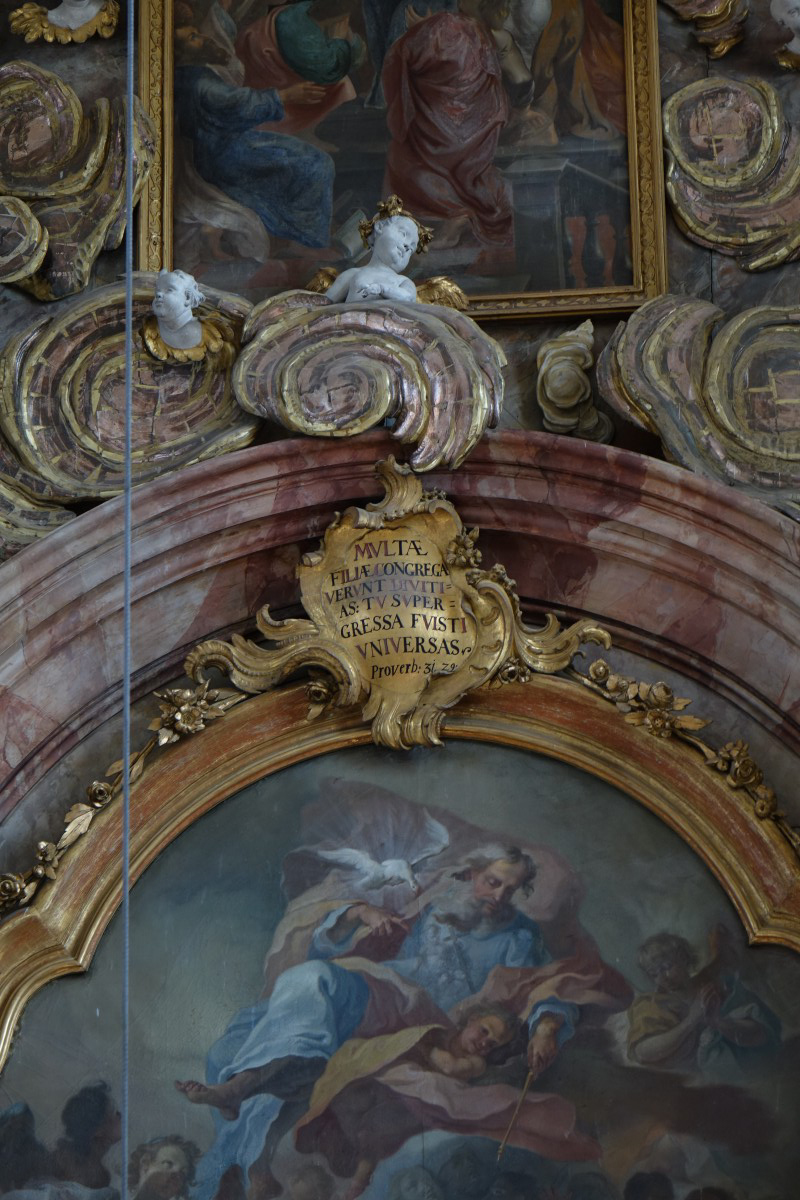
- MULTAE FILIAE CONGREGAVERUNT DIVI=TAS: TV SUPER=GRESSA FUISTI UNIVERSAS Proverb: 31.Z9: (Frame towelpainting cartouche on top)
- MARIA (in the painting under the crown)
- VIRGINI PARITURAE (in the painting left side from MARIA)
- JOHANNES IST SEIN NAME (book attribute of the right sculpture)
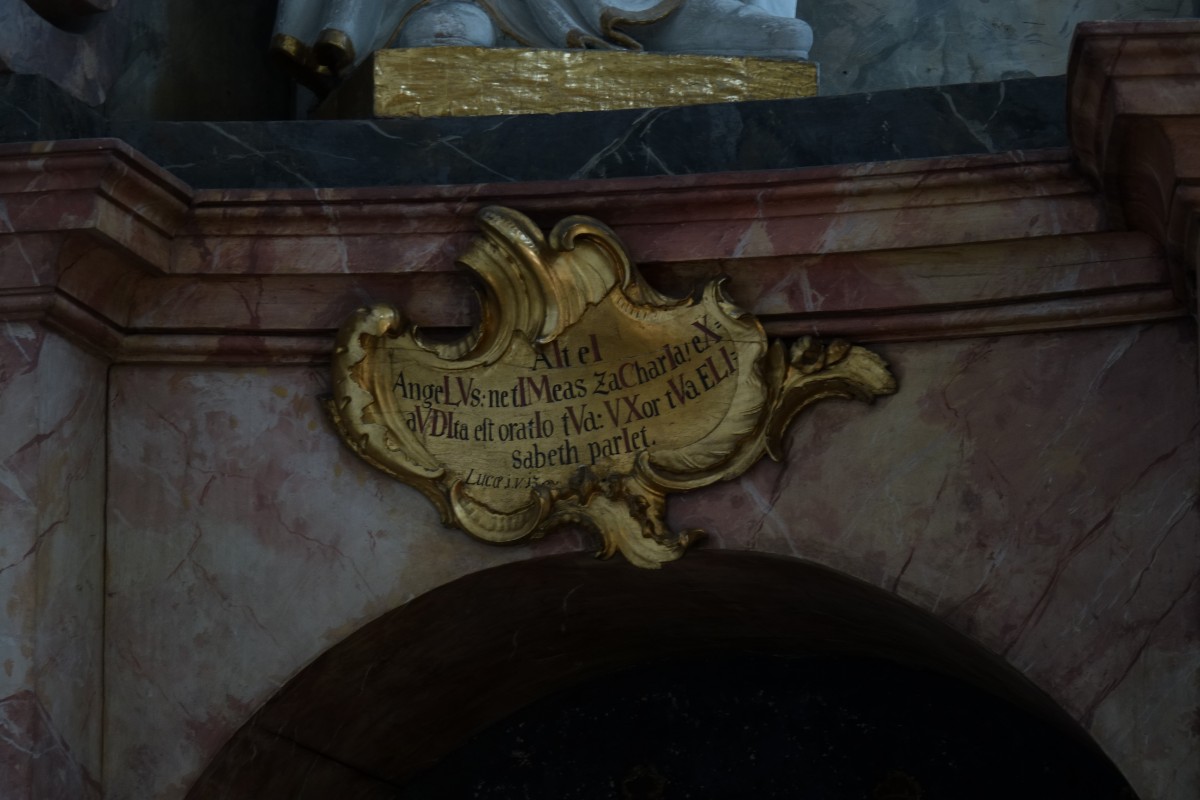
- AIteI AngeLVs:netIMeas zaChrIarIa! eX=aVDIta est oratIo tVa: VXor tVa ELI=sabeth parlet. Lucae J.v.13 (cartouche under the statue of Zacharias)
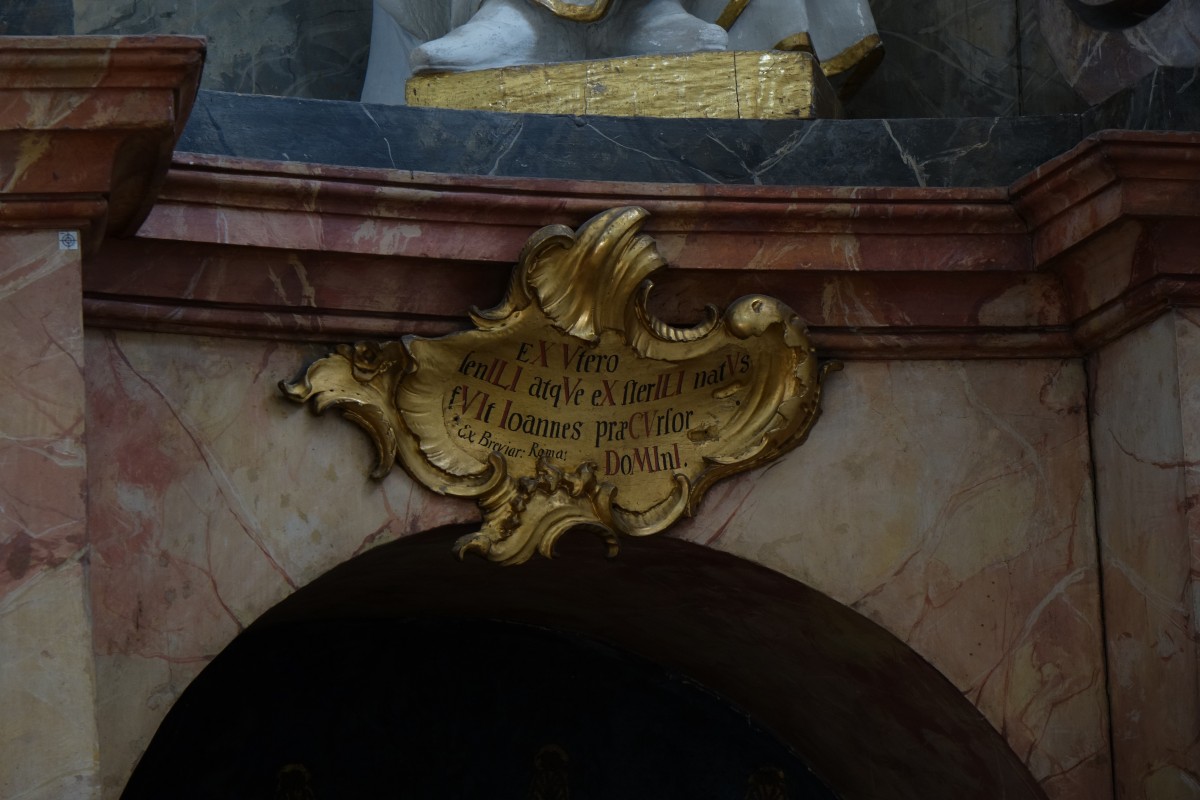
- EX Vtero SeIIli atqVe eX sterILI natVs fVIt Joannes praeCVrsor Ex Breviar: Roma DoMInI (cartouche under the statue of St Elisabeth)
Critical History
Lippert has listet the high altar with the number 63 together with 2 sculptures (7 feet high ) representing St Zacharias and St Elisabeth.1 All authors (Giedion-Welcker, Steiner, Volk) say that the altar was executed in 1750.2. The chronogram in the inscription under St Zacharias can be counted as1750. AIteI AngeLVs:netIMeas zaChrIarIa! eX=aVDIta est oratIo tVa: VXor tVa ELI=sabeth parlet. Lucae J.v.13
Construction / Execution
The huge altar and the sculptures are executed in wood. The painting layer of the architecture imitates marble, the sculptures have a monochrome white painting layer imitating a white stone material like marble or albaster. Some details are gilded. The painting layer was executed in 1766. The towelpainting was created by Bernhard Götz, Augsburg in 1742 .
Components
- Carpentry
- Completed: 1750
- Technique(s): sawing, wood carving
- Sculpture
- Author: Johann Baptist Straub (Wiesensteig ca. 1704 – Munich 1784)
- Completed: 1750
- Technique(s): wood carving
- Polychromy
- Completed: 1750
- Technique(s): polished white, water gilding
- Painting
- Author: Gottfried Bernhard Göz (Velehrad 1708 – Augsburg 1774)
- Technique(s): oil on canvas
Comment
There are no documents from the 18th century. The form of this altar seems to show a reaction to the surrounding architecture. Some profiles of the walls are repeated in wood.
The monastery was run by the religious order of the Carmelites. The same order as in Reisach where Straub equipped the church from 1747-1758. In 1812 -after secularisation- the churchs name was changed from S. Anna to the actual name.
The inscriptions under the two sculptures of St Zacharias and St Elisabeth show a chronogram in the text. The inscription under St Zacharias has the name of St Elizabeth in its text. Lippert documents a statue of St Anna and St Elisabetha but there are St Elisabeth and St Zacharias.
Conservation-restoration
- 1815
Treatment Description
After secularization the monastery was left. There were ideas to pull down the buildings of monastery. In 1815 there was a restoration. We dont know what kind of works were executed.
- 1853
Treatment Description
In 1853 all paintings were restored by the royal painter and restorer Josef Werberger from Munich.
- 1858
Treatment Description
In 1858 the painter and gilder Josef Schmalz restored the upper part of the tabernacle and the Holy Ghost for 7fl.
- 1898
Treatment Description
We just know that the local painter Xaver Stegmüller and his son restored the church for 16.000,- Mark.
- 1961
Strategy: removing one or several historic repolychromies
Treatment Description
In 1961 restoration by a local restorer Josef Lang. The intention was to receive a baroque room. The younger painting layers were almost completely removed.
Images
- The high altar of the Hospitalchurch of Holy Spirit St Anna photo Bavarian State Department of Monuments and Sites Michael Forstner 07.2017
- The high altar of the Hospitalchurch of Holy Spirit St Anna photo Bavarian State Department of Monuments and Sites Michael Forstner 07.2017
- The inscription in the cartouche of the towelpaintings frame at the highaltar of the Hospitalchurch of Holy Spirit St Anna, Schongau, cartouche above the main painting photo Bavarian State Department of Monuments and Sites Rupert Karbacher 04.2017
- The inscription under the sculpture of St John at the highaltar of the Hospitalchurch of Holy Spirit St Anna, Schongau photo Bavarian State Department of Monuments and Sites Rupert Karbacher 04.2017
- The inscription under the sculpture of St Anna in the hospitalchurch Holy Spirit St Anna, Schongau photo Bavarian State Department of Monuments and Sites Rupert Karbacher 04.2017
Catalogue entry prepared by Rupert Karbacher
Recommended citation: Rupert Karbacher, High Altar of the Hospital Church of the Holy Spirit in Schongau , in: TrArS – Tracing the Art of the Straub Family, 2018, (accessed 01/07/2026) URL
