Location
Croatia, Karlovac County, Karlovac
Parish church of the Magi (Župna crkva Sv. tri kralja)
Artwork
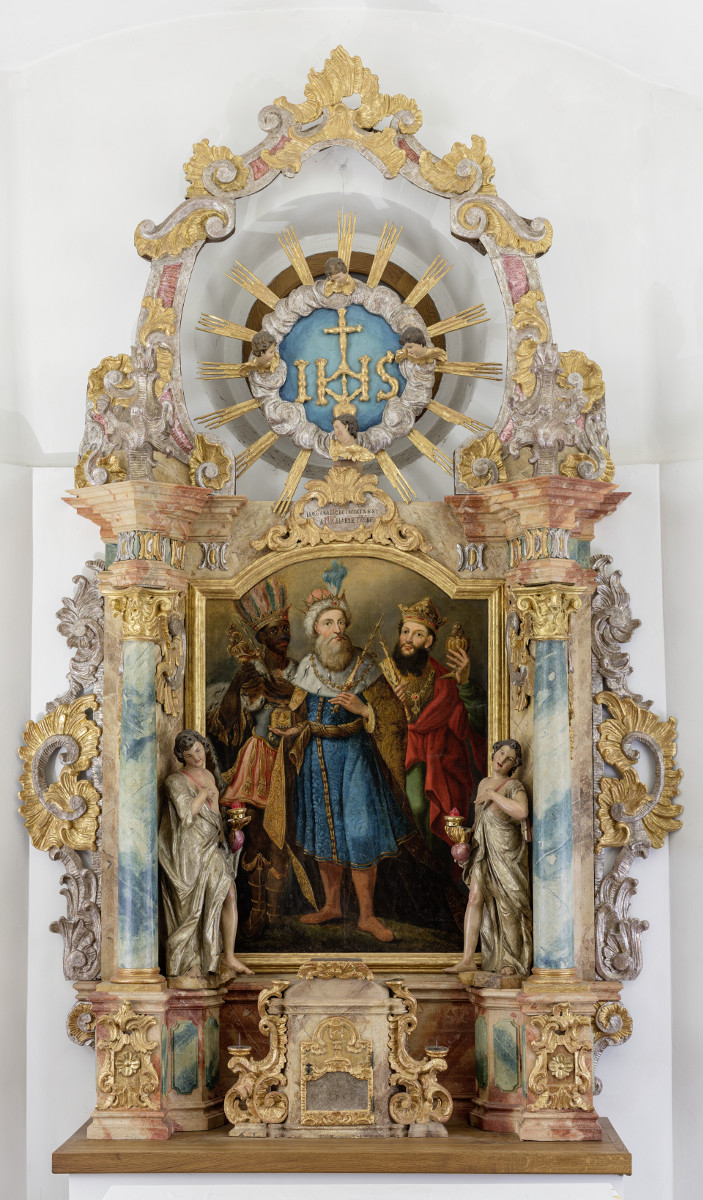
The High Altar of the Magi in Karlovac (Banija)
Type
High altar
Dimensions
Height: 445 cm, width: 277 cm, depth: 60 cm
Inscriptions
- HAEC ARAE VOTO DONATA EST / A MICHAELE TVZIBAT (on the cartouche above the painting)
- Sv. Tri Kralja (on the same cartouche before the removal of repolychromies)
- Mich. Schlechta pinx (on the lower right angle of the painting)
- Nj. jasnost Knez Albert Lamoral od Thurn i Taxis-a / Dr. Ivan Graho grad. načelnik / Vlado Milihram posjednik (on the antependium of the side altar)
Critical History
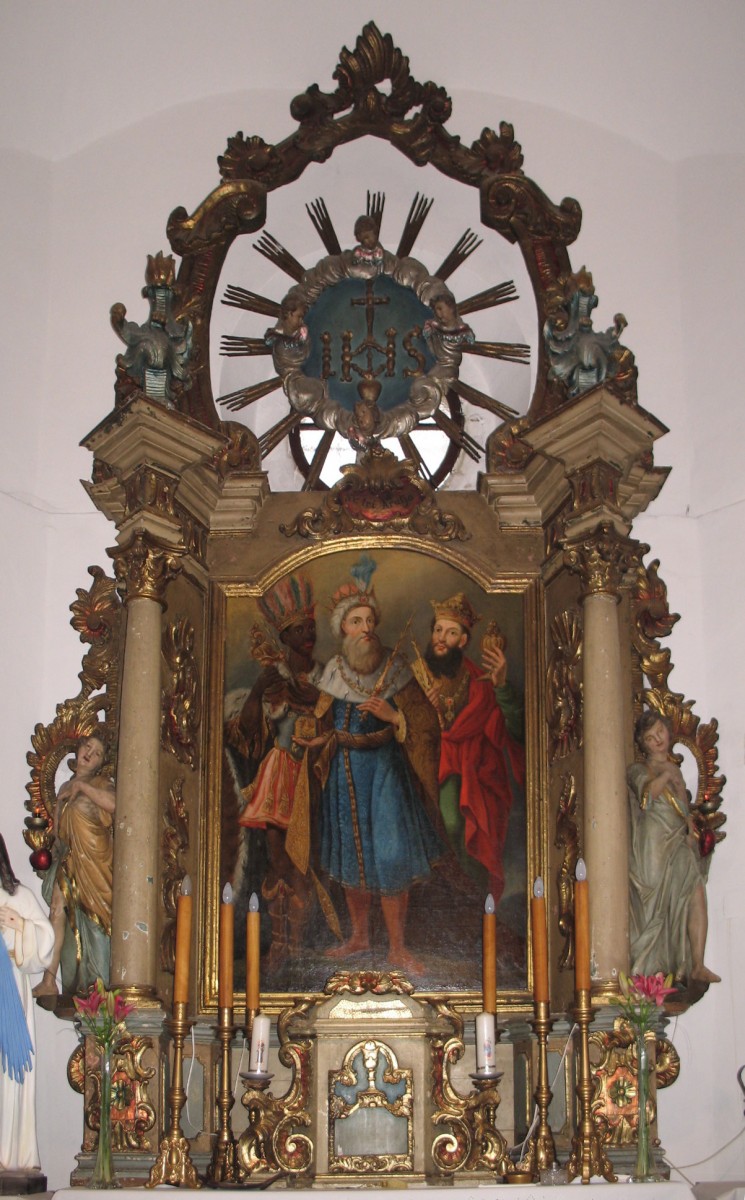
The votive chapel of the Magi was donated by the Karlovac merchant Mihalj Tucibat in 1759.1 The chapel furnished with three altars was first mentioned in the records of canonical visitation of 1771.2 According to the inscription (Ins. 1), the high altar was completed in 1762. 3 Doris Baričević attributed the sculptural work to Franz Anton Straub based on the stylistic comparison with the work of his brothers.4 The tabernacle dates from the same time.5 The original altar painting "The Adoration of the Magi" was painted in 1760 by Gabriel Taller, who was charged with the work following the wish of the general auditor Matija Hangel.6 Đurđica Cvitanović supposed that the painting was later repainted,7 but it was actually replaced by a new one painted by Michael Schlechta in 1820–1840 (Ins. 3), in the course of the thorough renovation of the chapel.8 The painting was in turn replaced by a copy. The conservator Tatjana Horvatić found Schlechta's painting on the church choir in 2005. Restoration works that followed revealed his signature.9 The polychromy from 1762 could be by Gabriel Taller who at the time lived in nearby Kamensko where he executed many artworks for the Pauline church.10 The altar has been renovated several times. The final repolychromy was carried out in 1936, when dr. Ivan Graho served as a mayor (Ins. 4). It was recorded in the parish cronicle the local wall-painter Rudolf Kralj was payed 3000 din. collected from parishioners to paint the walls and altars.11 The chapel became a parish church in 1969.
Construction / Execution
According to the restorers' insight, the plate behind the christogram might have been added later. If this is the case, then the original structure of the attic was even lighter than it is now, because the light from the oculus would outline the contour of the christogram.12
Components
- Carpentry
- Author: Franz Anton Straub (Wiesensteig 1726 – Zagreb ca. 1774)
- Completed: 1760
- Patron(s): Michael Tucibat, individual devotion
- Material(s): wood
- Sculpture
- Author: Franz Anton Straub (Wiesensteig 1726 – Zagreb ca. 1774)
- Completed: 1760
- Patron(s): Michael Tucibat, individual devotion
- Material(s): wood
- Painting
- The Adoration of the Magi
- Author: Gabriel Taller (Krakow? 1710 – Lepoglava 1780)
- Completed: 1760
- Technique(s): oil on canvas
- Painting
- The Adoration of the Magi
- Author: Michael Schlechta
- Completed: ca. 1820 – ca. 1840
- Technique(s): oil on canvas
- Painting
- The Adoration of the Magi
- Completed: 1970 – 1980
- Polychromy
- Author: Gabriel Taller (Krakow? 1710 – Lepoglava 1780)
- Completed: 1762
- Patron(s): Michael Tucibat, individual devotion
- Technique(s): water gilding
- Material(s): gold leaf, linseed oil, red bole, silver leaf
- Polychromy
- First repolychromy
- Technique(s): oil gilding
- Material(s): gold leaf
- Polychromy
- Second repolychromy
- Author: Rudolf Kralj
- Completed: 1936
- Patron(s): multiple, parishioners
- Material(s): metallic pigment
Comment
The original painting by Gabriel Taller has not been preserved. According to the conservation-restoration research, the marbled surfaces have been repainted three times, whereas the silvered and gilded ones have been repainted four times.13
Conservation-restoration
- 1979
Treatment Description
The painting "The Adoration of the Magi" was restored by Josip Restek in 1979.14
- 2007
Strategy: removing dirt, removing varnish
Approach to the presentation of losses
Reintegration of lacunae – mimetic: total
Materials: acetone, Beva 371, ethyl alcohol, methyl cellulose, Paraloid B-72, Plexisol, polyester canvas, white spirit
Treatment Description
The painting "The Adoration of the Magi" was restored by Zlatko Bielen in 2007. According to the restorer, the yellowish powdery ground indicates the 19th century technology.15
- 2012–2014
Strategy: removing one or several historic repolychromies
Approach to the presentation of losses
Reintegration of lacunae – mimetic: total
Reconstruction of losses: total
Materials: acetone, balsa wood, Carbopol, demineralized water, Ethomeen C/25, ethyl alcohol, gold leaf, limewood, mastic resin, paint stripper, Paraloid B-72, Planatol BB, rabbit-skin glue, red bole, shellack, Shellsol T, silver leaf, skin glue, toluene, white spirit, xylene, yellow bole
Treatment Description
The conservation-restoration of the altar was executed by the private company Dok-Art.16
Images
- The high altar in Karlovac, Banija (Croatian Conservation Institute Photo Archive, photo by Goran Tomljenović, 2017)
- The high altar before conservation (photo by Martina Ožanić, 2010)
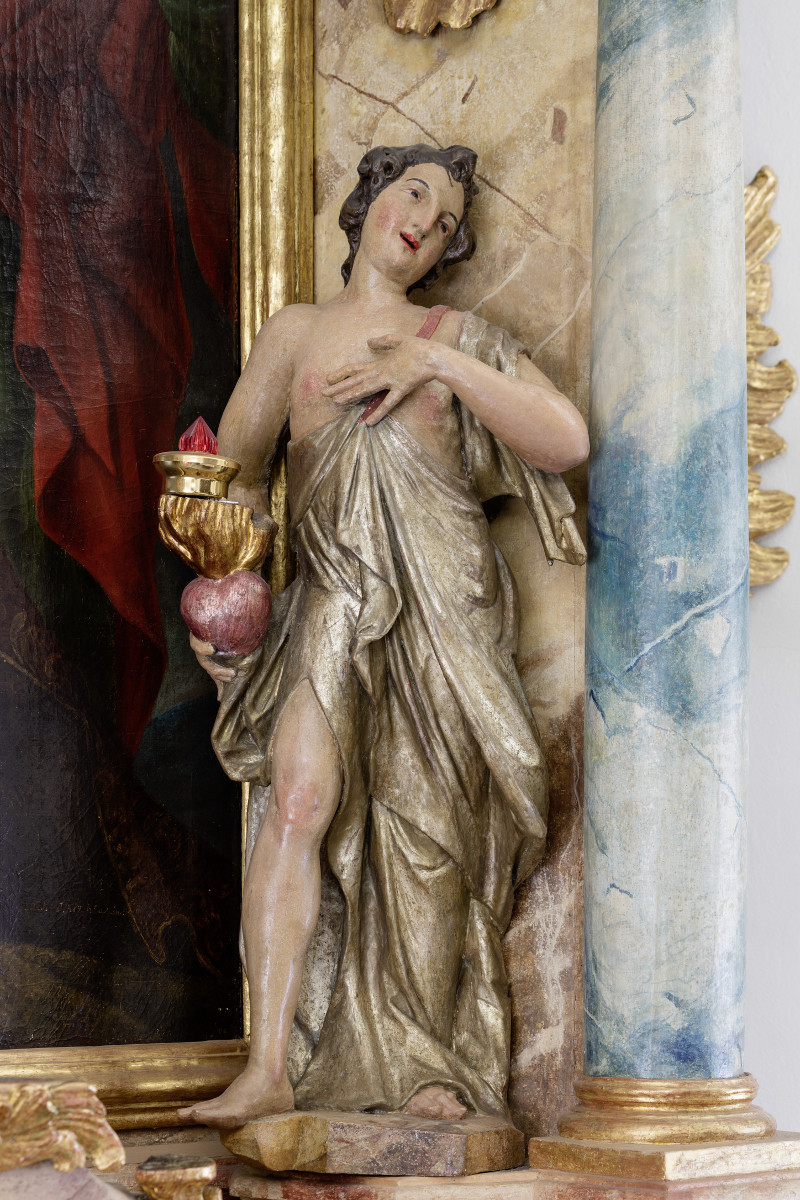
- The sculpture of angel (Croatian Conservation Institute Photo Archive, photo by Goran Tomljenović, 2017)
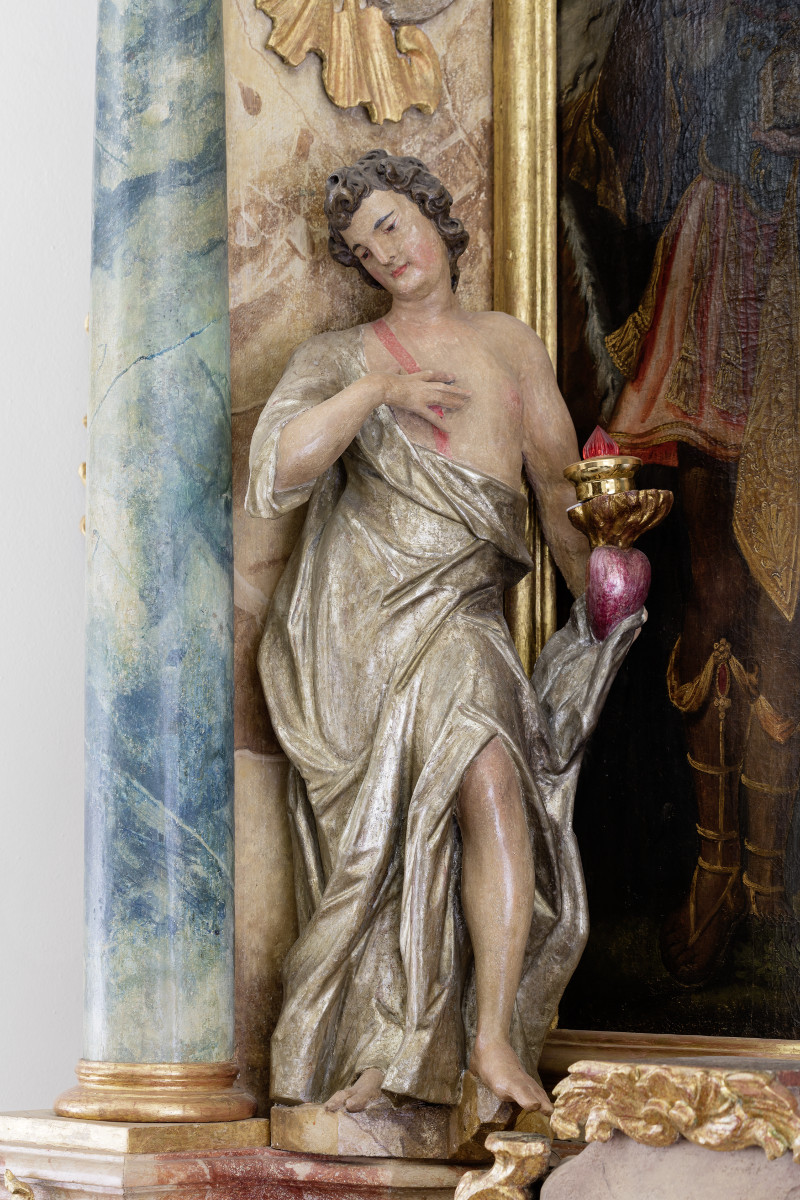
- The sculpture of angel (Croatian Conservation Institute Photo Archive, photo by Goran Tomljenović, 2017)
Catalogue entry prepared by Ksenija Škarić and Martina Ožanić
Recommended citation: Ksenija Škarić and Martina Ožanić, The High Altar of the Magi in Karlovac (Banija), in: TrArS – Tracing the Art of the Straub Family, 2018, (accessed 24/01/2026) URL
