Location
Austria, Styria, Graz
Diocesan Museum Graz (Diözesanmuseum Graz)
Innere Stadt
Original location:
Austria, Styria, Graz
Parish Church of the Holy Blood (Stadtpfarrkirche zum Heiligen Blut)
Innere Stadt
Artwork
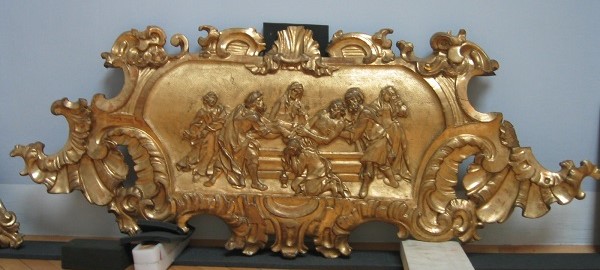
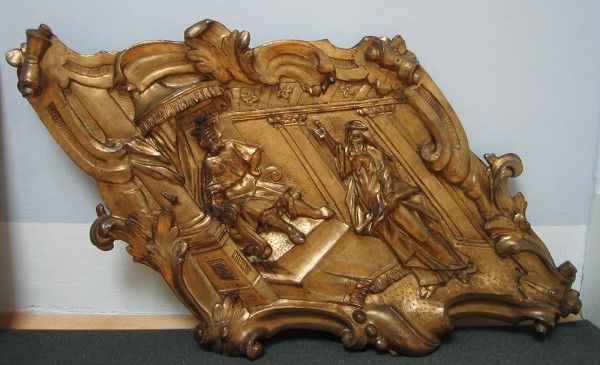
Nine reliefs from the pulpit of the Parish Church of the Holy Blood in Graz (now Diocesan Museum Graz)
Type
Pulpit
Critical History
Originally, the nine reliefs (1749–1750)1 were located in the parish church to the Holy Blood. They were part of the church’s baroque furnishing which was created between 1733 and 1750 and completely removed from 1875 within the neo-Gothic restoration.2
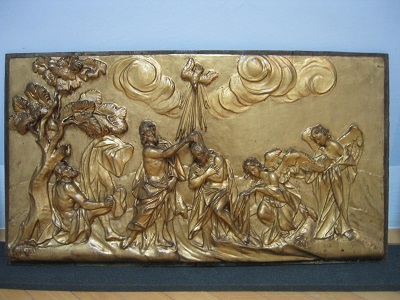
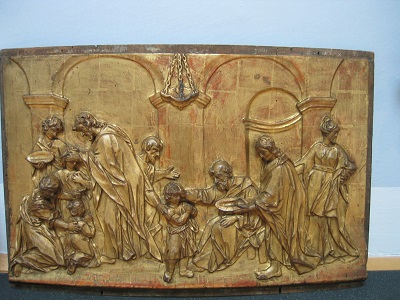
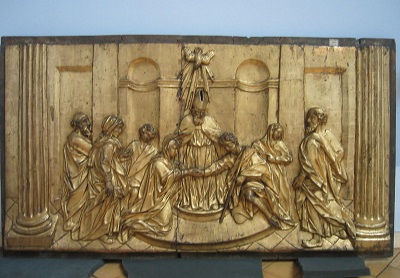
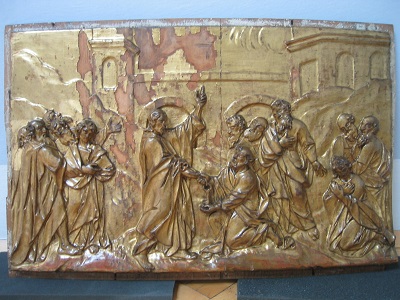
Seven of the pulpit-reliefs show the sacraments: The Baptism of Christ in the Jordan River, the Sacrament of Confirmation, the Sacrament of Penance (Magdalene anointes the feet of Christ), the Sacrament of Marriage (Marriage of the Virgin Mary), the Sacrament of the Holy Unction, Christ gives Peter the authority of the keys (Ordination) and the Sacrament of the Eucharist (Entombment of Christ). According to Horst Schweigert the reliefs enjoy a special iconographic status, because no other closed cycle of the “Seven Sacraments” from the 18th century could be documented so far. Philipp Jakob Straub followed the first version of the Seven Sacraments by Nicolas Poussin (1594–1665) from 1636 to 1639.3 The reliefs are attributable to Straub’s expressive period.
Two further reliefs represent scenes from the Old Testament: Moses before the Pharao and Moses with the Tablets of Commandments before the Israelite People.
Construction / Execution
The reliefs made of carved lime wood are entirely gilded. Originally, five reliefs were located at the parapet on the stair to the pulpit, four others at the pulpit itself. Their measurements vary between 44,5 cm and 59 to 69 cm. The latter show a rectangular shape with a convex curvature to the lateral margins. The other five reliefs show different shapes and sizes (width between 43 cm and 96 cm, length between 78 cm and 166 cm). Two of them are flat and rhombic-shaped cartouches, two are flat and rectangular and one is flat and of a more extensive format. The nine objects were carved out of a single piece of limewood, which was crudely worked vertically at the backside with a scrub plane.
Components
- Sculpture
- Author: Philipp Jakob Straub (Wiesensteig 1706 – Graz 1774)
- Completed: 1749 – 1750
- Technique(s): wood carving
- Material(s): limewood
- Polychromy
- Completed: 1749 – 1750
- Material(s): gold leaf, red bole
Conservation-restoration
- 2016
Strategy: removing dirt
Treatment Description
The reliefs show vertical cracks, traces of mounting, bumps, signs of abrasion, scratches as well as damages in the colouring. Former restoration works included: re-gilding, removal of the varnish, partial retouching, vertical glueing, coatings and patinatings. These were accompanied by dust, fly and dirt deposits. The difference in the appearance of the nine reliefs is the result of preceding retouching, which can be seen as document of the restoration. Therefore appropriate restoration procedures, thus a general and gentle cleaning was necessary. It is to be noted that the relief with the baptism of Christ was completely re-gilded for an exhibition in the Stadtmuseum Graz in 1992.4
Images
- Relief “Baptism of Christ in the Jordan River” (photo by Universalmuseum Joanneum, 2006)
- Relief “Sacrament of Confirmation” (photo by Universalmuseum Joanneum, 2006)
- Relief “Marriage of Virgin Mary” (photo by Universalmuseum Joanneum, 2006)
- Relief “Christ gives Peter the authority of the keys” (photo by Universalmuseum Joanneum, 2006)
- 7. Relief “Entombment of Christ” (photo by Universalmuseum Joanneum, 2006)
- Relief “Moses before the Pharao” (photo by Universalmuseum Joanneum, 2006)
Catalogue entry prepared by Christina Pichler and Dagmar Probst
Recommended citation: Christina Pichler and Dagmar Probst, Nine reliefs from the pulpit of the Parish Church of the Holy Blood in Graz (now Diocesan Museum Graz), in: TrArS – Tracing the Art of the Straub Family, 2018, (accessed 19/05/2026) URL
